
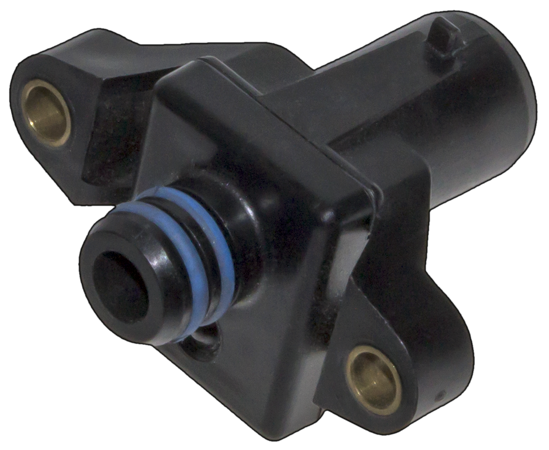
The Manifold Absolute Pressure (MAP) Sensor measures the pressure inside the engine’s intake manifold and converts it into a voltage signal that is sent to the vehicle’s ECU (Engine Control Unit). The ECU uses this data—along with information from other sensors—to determine the correct air/fuel mixture and ignition timing for optimal combustion.
The Barometric Pressure Sensor (BPS), also known as the Barometric Air Pressure (BAP) Sensor, measures the atmospheric air pressure outside the engine. It provides critical altitude-related data to the ECU, allowing it to adjust fuel delivery and ignition timing based on environmental conditions.
Together, the MAP and BAP sensors ensure the engine performs efficiently under varying loads and altitudes, maintaining proper fuel economy, power output, and emissions control.
How They Work:
- The MAP sensor detects intake manifold pressure using a diaphragm and piezoresistive element that changes voltage with pressure variations.
- The BAP sensor measures ambient air pressure using similar technology, often located near the air intake or integrated into the ECU.
- The ECU uses these combined readings to calculate engine load and adjust the air/fuel ratio for smooth performance.
- Accurate readings from both sensors help prevent detonation, hesitation, and inefficient combustion.
Product Features & Benefits from Walker Products:
- Exact OE Fit: Direct replacement ensures proper system function and easy installation.
- OE Replacement Quality: Meets or exceeds OE specifications for accuracy and durability.
- Durable Construction: Engineered to withstand heat, vibration, and contamination from harsh engine environments.
- Restores Engine Efficiency: Provides precise pressure readings to optimize fuel mixture and timing.
- Aftermarket Expertise: Backed by over 75 years of experience in sensor technology and engine management.
Symptoms of a Failing MAP or BAP/BPS Sensor
- Engine will not start or starts poorly.
- Detonation or misfire during acceleration.
- Poor fuel economy or excessive fuel consumption.
- Lack of engine power or hesitation.
- Check Engine Light (CEL) illuminated.
Common Check Engine Light (CEL) / OBD-II Codes
Since 1996, all vehicles have been equipped with OBD-II systems to standardize emissions and engine diagnostics. The following codes are commonly associated with MAP and BAP/BPS Sensors. They are provided as a general guide only.
Walker Products will not be held responsible for any use of this information. Always consult a qualified mechanic and follow manufacturer and EPA guidelines for diagnosis, replacement, and ECU/PCM relearn procedures.
- P0068 – MAP/MAF – Throttle Position Correlation
- P006A – MAP – Mass or Volume Air Flow Correlation
- P006B – MAP – Exhaust Pressure Correlation
- P006C – MAP – Turbocharger/Supercharger Inlet Pressure Correlation
- P00B8 – MAP – Mass or Volume Air Flow Correlation
- P0069 – Manifold Absolute Pressure – Barometric Pressure Correlation
- P0105 – Manifold Absolute Pressure/Barometric Pressure Circuit
- P0106 – Manifold Absolute Pressure/Barometric Pressure Circuit Range/Performance
- P0107 – Manifold Absolute Pressure/Barometric Pressure Circuit Low
- P0108 – Manifold Absolute Pressure/Barometric Pressure Circuit High
- P0109 – Manifold Absolute Pressure/Barometric Pressure Circuit Intermittent
- P023D – Manifold Absolute Pressure – Turbocharger/Supercharger Boost Correlation
- P023E – Manifold Absolute Pressure – Turbocharger/Supercharger Boost Correlation
- P2073 – Manifold Absolute Pressure/Mass Air Flow – Throttle Position Correlation
- P2074 – Manifold Absolute Pressure/Mass Air Flow – Throttle Position Correlation
- P2226 – Barometric Pressure Sensor “A” Circuit
- P2227 – Barometric Pressure Sensor “A” Circuit Range/Performance
- P2228 – Barometric Pressure Sensor “A” Circuit Low
- P2229 – Barometric Pressure Sensor “A” Circuit High
- P222A – Barometric Pressure Sensor “B” Circuit
- P222B – Barometric Pressure Sensor “B” Circuit Range/Performance
- P222C – Barometric Pressure Sensor “B” Circuit Low
- P222D – Barometric Pressure Sensor “B” Circuit High
- P222E – Barometric Pressure Sensor “B” Circuit Intermittent/Erratic
- P222F – Barometric Pressure Sensor “A”/“B” Correlation
- P2230 – Barometric Pressure Sensor “A” Circuit Intermittent/Erratic
- P2262 – Turbocharger/Supercharger Boost Pressure Not Detected
- P226B – Turbocharger/Supercharger Boost Pressure Too High – Mechanical
What does a manifold absolute pressure (MAP) sensor do?
A manifold absolute pressure (MAP) sensor measures the amount of air pressure inside the intake manifold. It sends this data to the engine control module (ECM), which uses it to calculate the correct air-fuel mixture and ignition timing.
What are the symptoms of a bad MAP sensor?
Common symptoms include rough idle, poor fuel economy, hesitation or stalling, hard starting, and reduced engine performance. The check engine light may also illuminate.
What happens when a MAP sensor fails?
When a MAP sensor fails, the ECM may receive incorrect pressure readings, leading to improper fuel delivery. This can result in poor engine performance, increased emissions, and possible stalling.
Can you drive with a bad MAP sensor?
While the vehicle may still run, it is not recommended. A failing MAP sensor can cause drivability issues such as stalling, hesitation, and decreased fuel efficiency.
What causes a MAP sensor to go bad?
MAP sensors can fail due to contamination from oil or carbon buildup, electrical issues, damaged wiring, or exposure to extreme heat and vibration.
Will a bad MAP sensor trigger a check engine light?
Yes, a faulty MAP sensor will typically trigger the check engine light and may store diagnostic trouble codes related to air pressure or engine load readings.
How do you reset or relearn a MAP sensor?
In many cases, the ECM will automatically adjust after the sensor is replaced. Some vehicles may require clearing codes with a scan tool or performing a relearn procedure based on manufacturer guidelines.
How is a MAP sensor different from a mass airflow (MAF) sensor?
A MAP sensor measures air pressure inside the intake manifold, while a MAF sensor measures the volume of air entering the engine. Both help determine proper fuel delivery but operate differently.
Can a bad MAP sensor cause poor fuel economy?
Yes, incorrect readings from a faulty MAP sensor can cause the engine to run too rich or too lean, negatively affecting fuel economy.
How long does a MAP sensor last?
MAP sensors are designed to last many years, but their lifespan depends on operating conditions, exposure to contaminants, and overall vehicle maintenance.
Can cleaning a MAP sensor fix the problem?
In some cases, carefully cleaning the sensor can remove buildup and restore accurate readings. However, if the sensor is electrically or mechanically damaged, replacement is recommended.
Which OBD-II codes are associated with MAP sensor problems?
Common codes include P0105 through P0109, depending on the specific circuit or performance issue detected by the ECM.