
Fuel Injectors—whether Throttle Body Injection (TBI), Port Fuel Injection (PFI), or Direct Injection (DI)—are precision-engineered components that deliver the exact amount of fuel to an engine under all operating conditions.
Controlled by the vehicle’s Powertrain Control Module (PCM) or Engine Control Unit (ECU), these injectors meter and atomize fuel into fine droplets to achieve the correct air/fuel ratio for combustion efficiency, performance, and reduced emissions.
- TBI Injectors spray fuel into the throttle body, similar to a carbureted system but with electronic precision.
- PFI Injectors deliver fuel directly into each intake runner, improving efficiency and power.
- Direct Injection (DI) injectors operate under very high pressure, spraying fuel directly into the combustion chamber for maximum control and efficiency.
How It Works
Fuel injectors are electronically activated valves designed to respond in milliseconds to ECU commands.
- When signaled, the injector opens, allowing pressurized fuel to flow through its precision orifice.
- The nozzle atomizes the fuel into a fine mist for optimal mixing with incoming air.
- The ECU adjusts the injector pulse width based on real-time data from sensors including the oxygen, throttle position, and mass air flow sensors.
This precise metering ensures efficient combustion, smooth engine performance, and minimal emissions.
Product Features & Benefits from Walker Products:
- Exact OE Fit: Direct-fit replacement ensures proper fit and function.
- OE Replacement Quality: Built to meet or exceed OEM flow and spray pattern specifications.
- Enhanced Durability: Resistant to fuel additives, ethanol, and contaminants.
- Precision Atomization: Optimized spray pattern for improved combustion and reduced emissions.
- Corrosion-Resistant Materials: Designed for long-term reliability in all fuel environments.
- Comprehensive Coverage: Available for TBI, PFI, and Direct Injection applications.
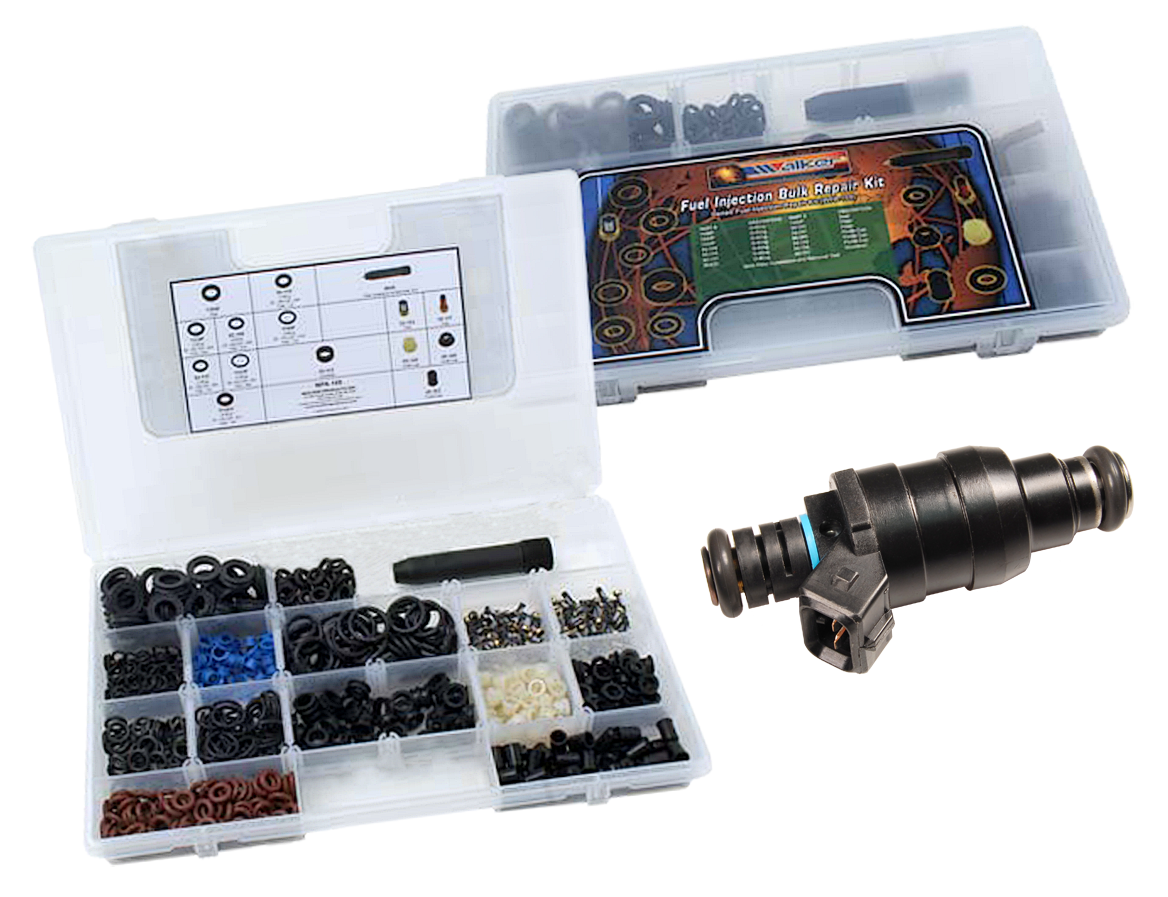
Fuel Injection Repair Kits
Walker Products offers a complete line of Fuel Injection Repair Kits to support both full and partial injector servicing.
Our range includes:
- Bulk packaging of components for shop environments.
- Individual injector service kits for single-unit repairs.
- Individual replacement parts such as O-rings, seals, pintle caps, and filters.
These kits are ideal for routine tune-ups, preventive maintenance, and injector reconditioning.
Symptoms of a Failing Fuel Injector
- Hard or no start conditions.
- Poor acceleration or hesitation.
- Engine surging or misfires.
- Rough idle or uneven RPMs.
- Decreased fuel economy.
- Illuminated Check Engine Light (CEL).
Early detection and replacement prevent further damage to the combustion system and maintain fuel efficiency.
Common Check Engine Light (CEL) / OBD-II Codes
To comply with the EPA’s OBD-II emissions monitoring standards, all post-1996 vehicles use diagnostic systems to detect engine performance faults. The following Diagnostic Trouble Codes (DTCs) are commonly associated with Fuel Injector or Fuel Trim issues.
Use this list as a guide only. Always consult a certified technician and follow manufacturer and EPA guidelines for diagnostics, replacement, and ECU relearn procedures.
- P00BB – Fuel Injector Insufficient Flow – Forced Limited Power
- P02CC – Cylinder 1 Fuel Injector Offset Learning At Min Limit
- P02CD – Cylinder 1 Fuel Injector Offset Learning At Max Limit
- P02CE – Cylinder 2 Fuel Injector Offset Learning At Min Limit
- P02CF – Cylinder 2 Fuel Injector Offset Learning At Max Limit
- P02D0 – Cylinder 3 Fuel Injector Offset Learning At Min Limit
- P02D1 – Cylinder 3 Fuel Injector Offset Learning At Max Limit
- P02D2 – Cylinder 4 Fuel Injector Offset Learning At Min Limit
- P02D3 – Cylinder 4 Fuel Injector Offset Learning At Max Limit
- P02D4 – Cylinder 5 Fuel Injector Offset Learning At Min Limit
- P02D5 – Cylinder 5 Fuel Injector Offset Learning At Max Limit
- P02D6 – Cylinder 6 Fuel Injector Offset Learning At Min Limit
- P02D7 – Cylinder 6 Fuel Injector Offset Learning At Max Limit
- P02D8 – Cylinder 7 Fuel Injector Offset Learning At Min Limit
- P02D9 – Cylinder 7 Fuel Injector Offset Learning At Max Limit
- P02DA – Cylinder 8 Fuel Injector Offset Learning At Min Limit
- P02DB – Cylinder 8 Fuel Injector Offset Learning At Max Limit
- P02DC – Cylinder 9 Fuel Injector Offset Learning At Min Limit
- P02DD – Cylinder 9 Fuel Injector Offset Learning At Max Limit
- P02DE – Cylinder 10 Fuel Injector Offset Learning At Min Limit
- P02DF – Cylinder 10 Fuel Injector Offset Learning At Max Limit
- P0611 – Fuel Injector Control Module Performance
- P0612 – Fuel Injector Control Module Relay Control
- P062B – Internal Control Module Fuel Injector Control Performance
- P062D – Fuel Injector Driver Circuit Performance
- P062E – Fuel Injector Driver Circuit Performance
- P2146 – Fuel Injector Group “A” Supply Voltage Circuit/Open
- P2147 – Fuel Injector Group “A” Supply Voltage Circuit Low
- P2148 – Fuel Injector Group “A” Supply Voltage Circuit High
- P2149 – Fuel Injector Group “B” Supply Voltage Circuit/Open
- P2150 – Fuel Injector Group “B” Supply Voltage Circuit Low
- P2151 – Fuel Injector Group “B” Supply Voltage Circuit High
- P2152 – Fuel Injector Group “C” Supply Voltage Circuit/Open
- P2153 – Fuel Injector Group “C” Supply Voltage Circuit Low
- P2154 – Fuel Injector Group “C” Supply Voltage Circuit High
- P2155 – Fuel Injector Group “D” Supply Voltage Circuit/Open
- P2156 – Fuel Injector Group “D” Supply Voltage Circuit Low
- P2157 – Fuel Injector Group “D” Supply Voltage Circuit High
- P216A – Fuel Injector Group “E” Supply Voltage Circuit/Open
- P216B – Fuel Injector Group “E” Supply Voltage Circuit Low
- P216C – Fuel Injector Group “E” Supply Voltage Circuit High
- P216D – Fuel Injector Group “F” Supply Voltage Circuit/Open
- P216E – Fuel Injector Group “F” Supply Voltage Circuit Low
- P216F – Fuel Injector Group “F” Supply Voltage Circuit High
- P217A – Fuel Injector Group “G” Supply Voltage Circuit/Open
- P217B – Fuel Injector Group “G” Supply Voltage Circuit Low
- P217C – Fuel Injector Group “G” Supply Voltage Circuit High
- P217D – Fuel Injector Group “H” Supply Voltage Circuit/Open
- P217E – Fuel Injector Group “H” Supply Voltage Circuit Low
- P217F – Fuel Injector Group “H” Supply Voltage Circuit High
- P268A – Fuel Injector Calibration not Learned/Programmed
- U0105 – Lost Communication With Fuel Injector Control Module
- U0306 – Software Incompatibility With Fuel Injector Control Module
- U0406 – Invalid Data Received From Fuel Injector Control Module
- P0171 – System Too Lean
- P0174 – System Too Lean
- P2096 – Post Catalyst Fuel Trim System Too Lean
- P2098 – Post Catalyst Fuel Trim System Too Lean
- P2177 – System Too Lean Off Idle
- P2179 – System Too Lean Off Idle
- P2187 – System Too Lean at Idle
- P2189 – System Too Lean at Idle
- P2191 – System Too Lean at Higher Load
- P2193 – System Too Lean at Higher Load
- P0172 – System Too Rich
- P0175 – System Too Rich
- P2097 – Post Catalyst Fuel Trim System Too Rich
- P2099 – Post Catalyst Fuel Trim System Too Rich
- P2178 – System Too Rich Off Idle
- P2180 – System Too Rich Off Idle
- P2188 – System Too Rich at Idle
- P2190 – System Too Rich at Idle
- P2192 – System Too Rich at Higher Load
- P2194 – System Too Rich at Higher Load
- P0170 – Fuel Trim
- P0173 – Fuel Trim
- P029A Cylinder 1 – Fuel Trim at Max Limit
- P029B Cylinder 1 – Fuel Trim at Min Limit
- P029E Cylinder 2 – Fuel Trim at Max Limit
- P029F Cylinder 2 – Fuel Trim at Min Limit
- P02A2 Cylinder 3 – Fuel Trim at Max Limit
- P02A3 Cylinder 3 – Fuel Trim at Min Limit
- P02A6 Cylinder 4 – Fuel Trim at Max Limit
- P02A7 Cylinder 4 – Fuel Trim at Min Limit
- P02AA Cylinder 5 – Fuel Trim at Max Limit
- P02AB Cylinder 5 – Fuel Trim at Min Limit
- P02AE Cylinder 6 – Fuel Trim at Max Limit
- P02AF Cylinder 6 – Fuel Trim at Min Limit
- P02B2 Cylinder 7 – Fuel Trim at Max Limit
- P02B3 Cylinder 7 – Fuel Trim at Min Limit
- P02B6 Cylinder 8 – Fuel Trim at Max Limit
- P02B7 Cylinder 8 – Fuel Trim at Min Limit
- P02BA Cylinder 9 – Fuel Trim at Max Limit
- P02BB Cylinder 9 – Fuel Trim at Min Limit
- P02BE Cylinder 10 – Fuel Trim at Max Limit
- P02BF Cylinder 10 – Fuel Trim at Min Limit
- P02C2 Cylinder 11 – Fuel Trim at Max Limit
- P02C3 Cylinder 11 – Fuel Trim at Min Limit
- P02C6 Cylinder 12 – Fuel Trim at Max Limit
- P02C7 Cylinder 12 – Fuel Trim at Min Limit