
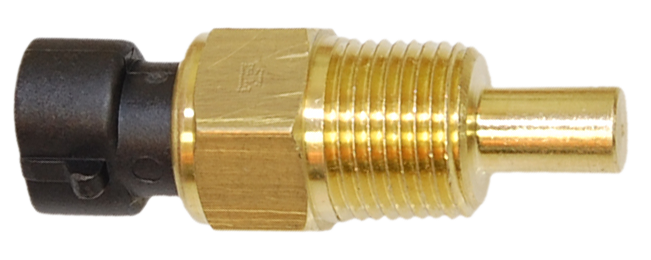
The Engine Coolant Temperature (CTS/ECT) Sensor uses electrical resistance to measure the temperature of the coolant/antifreeze mixture. The ECU uses this data to keep engine temperature in the ideal range—controlling cooling fan operation, EGR function, and fuel mixture enrichment as needed.
How It Works:
- Measures coolant temperature via a temperature-sensitive resistor.
- Sends a changing voltage/signal to the ECU as temperature rises/falls.
- The ECU adjusts cooling fan, EGR, and fuel mixture to maintain proper engine temperature and driveability.
Product Features & Benefits from Walker Products:
- Exact OE Fit: Direct replacement for quick, hassle-free installation.
- OE Replacement Quality: Built to meet or exceed OE performance specifications.
- Durable Construction: Designed to resist heat, vibration, and corrosion at the connector/terminal.
- Restores Performance & Efficiency: Provides accurate temperature data for proper fan control, fueling, and emissions.
- Aftermarket Expertise: Backed by over 75 years supplying reliable engine management components.
Symptoms of a Failing CTS/ECT:
- Reduced fuel efficiency
- Poor start
- Black smoke from the exhaust
- Overheating engine
- Poor idle (needing to press the gas pedal to keep running)
- Check Engine Light on
Common Check Engine Light (CEL) / OBD-II Codes
In 1996 the EPA required OBD-II on all passenger vehicles, standardizing emissions and fault diagnostics across manufacturers (later expanded to heavy-duty applications).
The codes below are common for this product type. Always consult a professional mechanic and follow vehicle manufacturer and EPA guidelines for diagnosis, replacement, code clearing, and ECU/PCM relearn procedures. Walker Products will not be responsible for use of this information.
- P008F – Engine Coolant Temperature/Fuel Temperature Correlation
- P00B1 – Radiator Coolant Temperature Sensor Circuit
- P00B2 – Radiator Coolant Temperature Sensor Circuit Range/Performance
- P00B3 – Radiator Coolant Temperature Sensor Circuit Low
- P00B4 – Radiator Coolant Temperature Sensor Circuit High
- P00B5 – Radiator Coolant Temperature Sensor Circuit Intermittent/Erratic
- P00B6 – Radiator Coolant Temperature/Engine Coolant Temperature
- P0115 – Engine Coolant Temperature Sensor 1 Circuit
- P0116 – Engine Coolant Temperature Sensor 1 Circuit Range/Performance
- P0117 – Engine Coolant Temperature Sensor 1 Circuit Low
- P0118 – Engine Coolant Temperature Sensor 1 Circuit High
- P0119 – Engine Coolant Temperature Sensor 1 Circuit Intermittent
- P011A – Engine Coolant Temperature Sensor 1/2 Correlation
- P011B – Engine Coolant Temperature/Intake Air Temperature Correlation
- P0125 – Insufficient Coolant Temperature for Closed Loop Fuel Control
- P0126 – Insufficient Coolant Temperature for Stable Operation
- P0128 – Coolant Thermostat (Coolant Temperature Below Thermostat …)
- P050C – Cold Start Engine Coolant Temperature Performance
- P060F – Internal Control Module Coolant Temperature Performance
- P063F – Auto Configuration Engine Coolant Temperature Input not Present
- P0A00 – Motor Electronics Coolant Temperature Sensor Circuit
- P0A02 – Motor Electronics Coolant Temperature Sensor Circuit Low
- P0A03 – Motor Electronics Coolant Temperature Sensor Circuit High
- P0A04 – Motor Electronics Coolant Temperature Sensor Circuit Intermittent
- P0C42 – Hybrid Battery Pack Coolant Temperature Sensor Circuit
- P0C43 – Hybrid Battery Pack Coolant Temperature Sensor Circuit
- P0C44 – Hybrid Battery Pack Coolant Temperature Sensor Circuit Low
- P0C45 – Hybrid Battery Pack Coolant Temperature Sensor Circuit High
- P0C46 – Hybrid Battery Pack Coolant Temperature Sensor Circuit
- P2182 – Engine Coolant Temperature Sensor 2 Circuit
- P2183 – Engine Coolant Temperature Sensor 2 Circuit Range/Performance
- P2184 – Engine Coolant Temperature Sensor 2 Circuit Low
- P2185 – Engine Coolant Temperature Sensor 2 Circuit High
- P2186 – Engine Coolant Temperature Sensor 2 Circuit Intermittent/Erratic
- U0116 – Lost Communication With Coolant Temperature Control Module
- U0456 – Invalid Data Received From Coolant Temperature Control Module
What does an engine coolant temperature sensor do?
An engine coolant temperature sensor monitors the temperature of the engine’s coolant and sends that data to the engine control module (ECM). This helps regulate fuel delivery, ignition timing, and cooling system operation.
Is an engine coolant temperature sensor the same as an ECT sensor?
Yes. The terms engine coolant temperature sensor and ECT sensor are commonly used interchangeably. Both refer to the component that measures coolant temperature for engine management.
Where is the engine coolant temperature sensor located?
An engine coolant temperature sensor is typically located near the engine thermostat housing or in the cylinder head, where it can accurately measure coolant temperature.
What happens when an engine coolant temperature sensor fails?
A faulty engine coolant temperature sensor can send incorrect temperature data, which may cause improper fuel adjustments and cooling system operation.
Will a bad engine coolant temperature sensor trigger a Check Engine Light?
Yes. A failing engine coolant temperature sensor can trigger a diagnostic trouble code (DTC) and illuminate the Check Engine Light.
Can you drive with a bad engine coolant temperature sensor?
In some cases, yes—but it can lead to overheating or poor engine performance. It’s best to replace a faulty engine coolant temperature sensor as soon as possible.
Is replacing an engine coolant temperature sensor difficult?
Replacing an engine coolant temperature sensor is usually straightforward, but proper handling of coolant and sealing is important to prevent leaks.
Why is a high-quality engine coolant temperature sensor important?
A high-quality engine coolant temperature sensor ensures accurate temperature readings, helping maintain proper engine performance, fuel efficiency, and reliable cooling system operation.