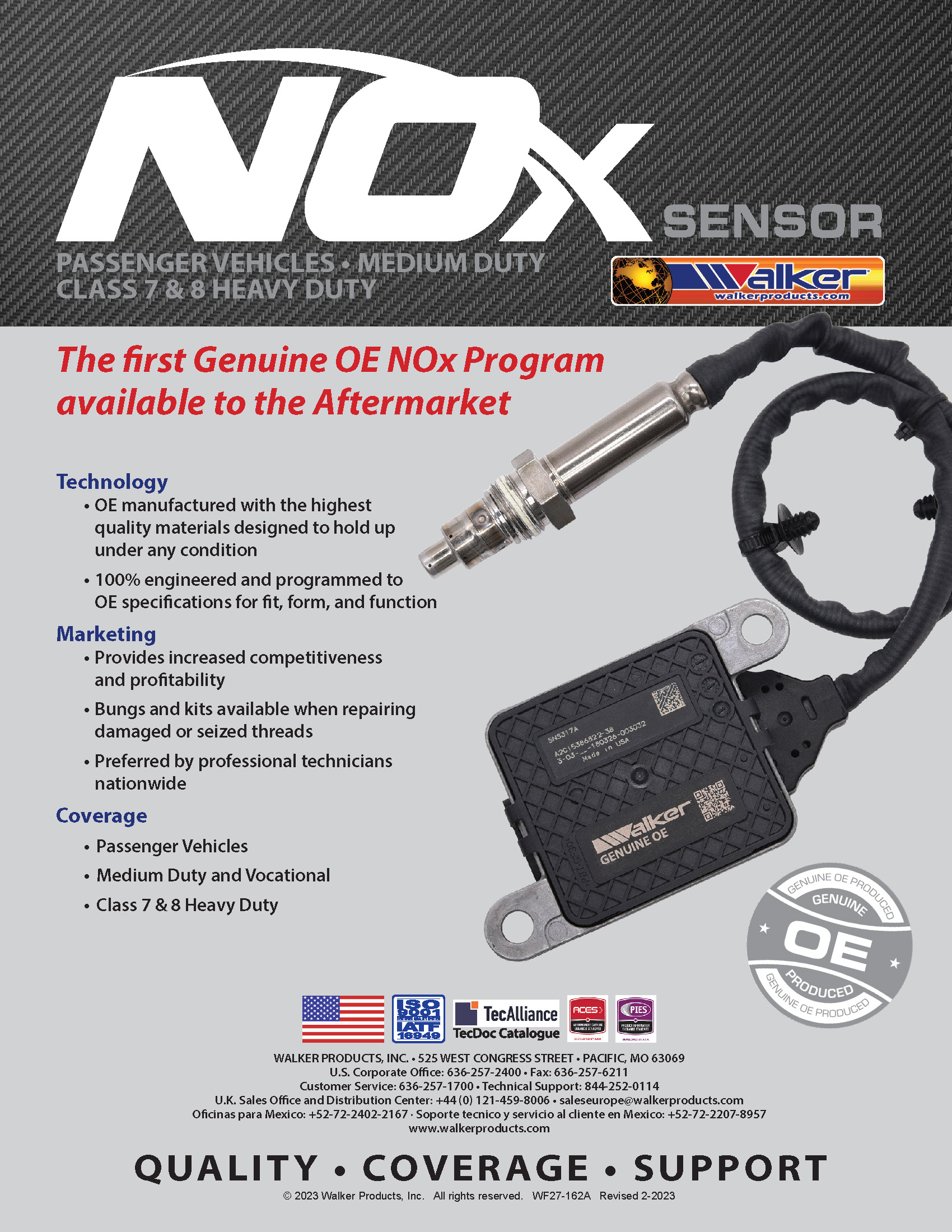
First Genuine OE NOx Program Available to the Aftermarket!
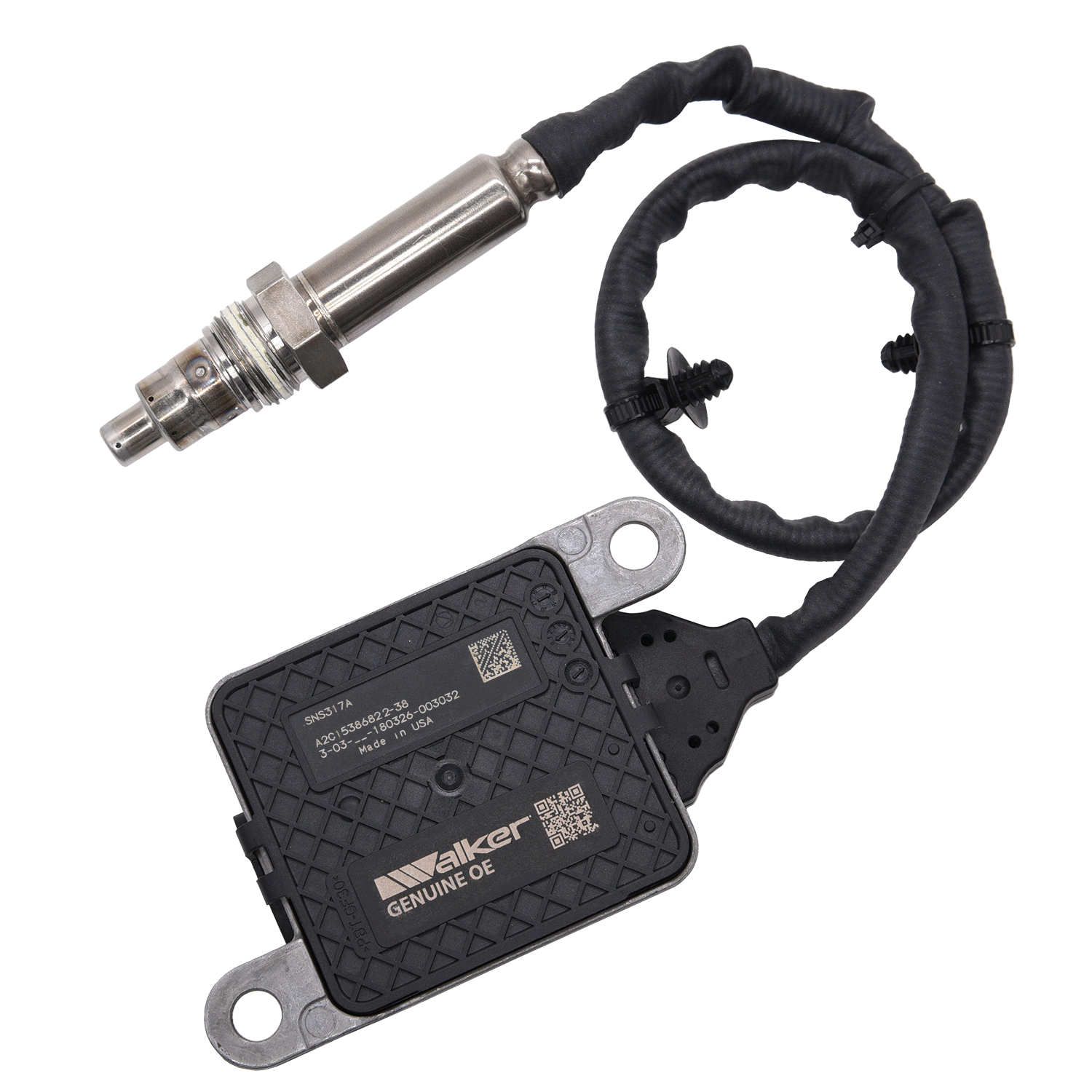
Walker Products proudly introduces the first Genuine OE NOx program designed specifically for the aftermarket. These premium sensors represent Tier 1 quality and reliability, engineered to deliver OE performance without compromise.
Unlike remanufactured alternatives, Walker NOx sensors are 100% Genuine OE NEW, ensuring no core charge, lower costs, and maximum profitability for distributors and service professionals.
NOx sensors play a vital role in today’s emissions control systems, continuously monitoring nitrogen oxide (NOx) levels in the exhaust stream.
They detect nitric oxide (NO), nitrogen dioxide (NO₂), and nitrous oxide (N₂O) concentrations, sending precise data to the Engine Control Module (ECM). The ECM then uses this data to:

- Regulate air-fuel mixture and combustion efficiency
- Control Selective Catalytic Reduction (SCR) dosing
- Maintain emission compliance and optimal performance across operating conditions
How It Works:
- A sensing cell inside the NOx sensor detects the concentration of nitrogen oxides in exhaust gases.
- This data is transmitted as a voltage or current signal to the ECM.
- The ECM uses this feedback to adjust fuel injection, EGR rates, and urea (DEF) dosing to meet emissions targets.
- When NOx levels exceed the allowable threshold, the ECM can trigger diagnostic trouble codes (DTCs) or limp mode to protect the system.
Development and Evolution
The development of NOx sensors began in the 1990s, with commercial use expanding through the early 2000s. Originally limited to lean-burn gasoline and diesel vehicles, NOx sensors became standard by 2010 on vehicles equipped with SCR systems.
Today, they’re used in passenger cars, light-duty trucks, heavy-duty trucks, buses, construction equipment, and agricultural machinery — making them an essential component in modern emission systems.
Lifespan and Failure
Typical NOx sensor lifespan ranges between 100,000–150,000 miles, depending on engine operating conditions and fuel quality.
As sensors age or degrade, the ECM logs fault codes and may trigger emergency (limp) mode, often causing:
- Increased fuel consumption
- Reduced engine power
- Unstable idle or emission system faults
Symptoms of a Failing NOx Sensor:
- Decreased fuel economy
- Unstable idle or rough running
- Increased emissions output
- Check Engine Light (MIL) illuminated
Product Features & Benefits from Walker Products:
- 100% Genuine OE New: No remanufacturing, no core charge — reduces downtime and simplifies installation
- OE Fit, Form, and Function: Engineered to original specifications for plug-and-play compatibility
- Made in the USA: Built using premium materials and advanced manufacturing processes
- Tier 1 Quality Assurance: Meets or exceeds OEM standards for accuracy and durability
- Comprehensive Coverage: Passenger, medium duty, vocational, and Class 7–8 heavy-duty applications
Coverage Across Leading Engine and Truck Brands
Heavy Duty Class 7 & 8

Light & Medium Duty

Agriculture & Industrial

With coverage for Passenger Vehicles, Medium Duty, and Vocational, as well as Class 7 & 8 Heavy Duty trucks, Walker ensures quality, extensive coverage, and unwavering support.
Common Check Engine Light (CEL) / OBD-II Codes
In accordance with the EPA’s OBD-II standards (adopted in 1996 and later expanded to heavy-duty applications), the following Diagnostic Trouble Codes (DTCs) are commonly associated with NOx Sensors.
Use this list as a general reference only. Always consult a qualified technician and follow vehicle manufacturer and EPA guidelines for diagnostics, sensor replacement, and ECU/PCM relearn procedures.
- P2000 – NOx Adsorber Efficiency Below Threshold
- P2001 – NOx Adsorber Efficiency Below Threshold
- P20EC – SCR NOx Catalyst – Over Temperature
- P20ED – SCR NOx Pre-Catalyst – Over Temperature
- P20EE – SCR NOx Catalyst Efficiency Below Threshold
- P20EF – SCR NOx Pre-Catalyst Efficiency Below Threshold
- P20F0 – SCR NOx Catalyst – Over Temperature
- P20F1 – SCR NOx Pre-Catalyst – Over Temperature
- P20F2 – SCR NOx Catalyst Efficiency Below Threshold
- P20F3 – SCR NOx Pre-Catalyst Efficiency Below Threshold
- P2200–P2225 Series – NOx Sensor Circuit, Heater Control, and Sense Circuit Faults
- P2BA7–P2BAE Series – NOx Exceedance, Reagent, and EGR Flow Errors
- U029D / U029E – Lost Communication with NOx Sensor “A” / “B”
- U059E / U059F – Invalid Data Received from NOx Sensor “A” / “B”