
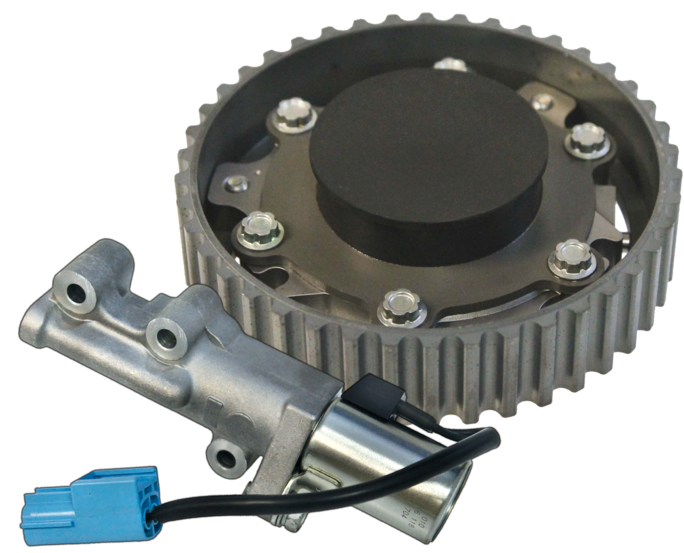
The Engine Variable Valve Timing (VVT) Solenoid controls the flow of oil pressure to the Variable Timing Sprocket (VTS)—also known as the Cam Phaser. This mechanism allows the camshaft timing to advance or retard based on engine speed and load, optimizing performance, fuel economy, and emissions.
The Cam Phaser (VTS) connects the camshaft to the timing chain or belt and synchronizes its rotation with the crankshaft. When functioning correctly, the VVT system adjusts timing automatically at various RPM ranges to ensure smooth power delivery and efficient fuel combustion.
How It Works:
- The VVT Solenoid receives commands from the ECU (Engine Control Unit).
- It directs pressurized engine oil to the Variable Timing Sprocket.
- This pressure actuates the cam phaser, advancing or retarding camshaft timing.
- The system continuously adjusts timing to deliver optimal engine performance, fuel efficiency, and reduced emissions.
- The process improves power output during acceleration while maintaining low emissions under light load.
Product Features & Benefits from Walker Products:
- Exact OE Fit: Direct-fit replacement ensures precise oil flow control and reliable VVT operation.
- OE Replacement Quality: Manufactured to meet or exceed OE standards for performance and durability.
- Durable Construction: Engineered to withstand heat, oil contamination, and vibration for long-term reliability.
- Restores Efficiency: Returns proper camshaft timing and engine smoothness.
- Aftermarket Expertise: Supported by over 75 years of Walker Products’ experience in advanced engine management technology.
Symptoms of a Failing Variable Timing Solenoid:
- Rough or unstable idle.
- Decrease in fuel efficiency.
- Engine stumbles or hesitates under load or uphill driving.
- Loud and rough idle or metallic engine noise.
- Engine knock or poor acceleration at high RPM.
- Check Engine Light (CEL) illuminated.
Common Check Engine Light (CEL) / OBD-II Codes
Since 1996, all vehicles have used OBD-II systems to monitor engine emissions and performance. The following codes are commonly associated with Variable Valve Timing Solenoids (VVT) and are provided as a general reference only.
Walker Products will not be held responsible for any use of this information. Always consult a qualified technician and follow manufacturer and EPA guidelines for proper diagnostics, replacement, and ECU/PCM relearn procedures.
- P0010 – Camshaft Position Actuator Circuit Bank 1
- P0011 – Camshaft Position Timing Over-Advanced or System Fault Bank 1
- P0012 – Camshaft Position Timing Over-Retarded Bank 1
- P0013 – Camshaft Position Actuator Circuit Bank 1
- P0014 – Camshaft Position Timing Over-Advanced or System Fault Bank 1
- P0015 – Camshaft Position Timing Over-Retarded Bank 1
- P0020 – Camshaft Position Actuator Circuit Bank 2
- P0021 – Camshaft Position Timing Over-Advanced or System Fault Bank 2
- P0022 – Camshaft Position Timing Over-Retarded Bank 2
- P0023 – Camshaft Position Actuator Circuit Bank 2
- P0024 – Camshaft Position Timing Over-Advanced or System Fault Bank 2
- P0025 – Camshaft Position Timing Over-Retarded Bank 2
- P1349 – Variable Valve Timing System Malfunction Bank 1
What does a variable valve timing solenoid do?
A variable valve timing (VVT) solenoid controls the flow of oil to the VVT system, which adjusts the timing of the engine’s intake and exhaust valves. This helps improve engine performance, fuel efficiency, and emissions.
What is a VVT sprocket and what does it do?
A VVT sprocket (also called a cam phaser) works with the VVT solenoid to adjust camshaft timing. It changes the position of the camshaft relative to the crankshaft, allowing the engine to optimize valve timing for different driving conditions.
Why is variable valve timing important for engine performance?
Variable valve timing improves engine efficiency by adjusting valve operation based on speed and load. This results in better fuel economy, smoother acceleration, increased power, and reduced emissions.
Can I drive with a faulty VVT solenoid or sprocket?
While the vehicle may still operate, it’s not recommended. A faulty VVT solenoid or sprocket can cause improper valve timing, leading to reduced engine performance and efficiency over time.
Is a VVT solenoid the same as a camshaft position sensor?
No. A VVT solenoid controls oil flow to adjust valve timing, while a camshaft position sensor monitors the position of the camshaft and sends that data to the engine control module.
How do I know if my variable valve timing system is working properly?
You can verify proper operation using a diagnostic scan tool to monitor VVT performance or by checking for inconsistent engine performance. A technician can also test the VVT solenoid and sprocket directly if needed.
Are VVT solenoids and sprockets vehicle-specific?
Yes. Variable valve timing solenoids and sprockets are designed for specific vehicle makes and models to ensure proper fit, timing accuracy, and communication with the engine management system.
Will a bad VVT solenoid or sprocket trigger a check engine light?
Yes. If the variable valve timing solenoid or sprocket sends incorrect data or fails to operate properly, the engine control module may trigger the Check Engine Light and store a diagnostic trouble code (DTC).