
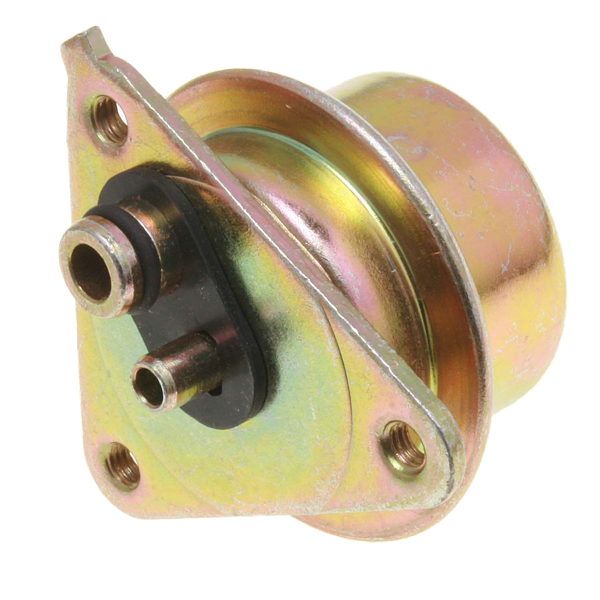
The Fuel Pressure Regulator (FPR) is a vital component in the fuel delivery system that maintains the correct pressure within the fuel rail to ensure proper fuel injector operation.
Depending on the vehicle design, the FPR is controlled either:
- Electronically through the Powertrain Control Module (PCM) or Engine Control Unit (ECU), or
- Mechanically through vacuum pressure.
Both methods serve to regulate fuel pressure dynamically based on engine RPM, load, and driving conditions. This consistent pressure allows the injectors to deliver precise fuel flow for efficient combustion, performance, and emissions control.
How It Works:
- The FPR continuously adjusts the fuel rail pressure to match the engine’s demand.
- When fuel demand increases, the regulator allows more flow to maintain proper pressure.
- During light load or idle conditions, the regulator reduces fuel flow to prevent excessive pressure.
- The ECU monitors fuel pressure through sensors, making real-time corrections when necessary.
This system ensures that injectors operate under optimal conditions for accurate fuel atomization and consistent engine performance.
Product Features & Benefits from Walker Products:
- Exact OE Fit: Direct-fit design for fast, reliable installation.
- OE Replacement Quality: Meets or exceeds OEM standards for fuel pressure control and performance.
- Precision Regulation: Maintains consistent pressure under all load conditions for proper injector performance.
- Durable Construction: Built from corrosion-resistant materials to withstand harsh fuel environments.
- Optimized Performance: Helps restore engine smoothness, fuel efficiency, and proper emissions.
- Comprehensive Coverage: Available for electronic and vacuum-operated fuel systems.
 Symptoms of a Failing Fuel Pressure Regulator:
- Hard starting or no start condition.
- Engine surging or uneven acceleration.
- Black smoke emitted from the exhaust.
- Loss of power or hesitation during deceleration.
- Reduced fuel economy.
- Illuminated Check Engine Light (CEL).
If ignored, fuel pressure irregularities can cause engine misfires, injector flooding, or even catalytic converter damage.
Common Check Engine Light (CEL) / OBD-II Codes
In accordance with EPA OBD-II standards, all post-1996 vehicles use onboard diagnostics to monitor emission and fuel system performance. The following Diagnostic Trouble Codes (DTCs) are commonly associated with Fuel Pressure Regulator (FPR) faults.
These codes should be used as a general guide only. Always consult a qualified technician and follow vehicle manufacturer and EPA guidelines when performing diagnostics, replacement, or ECU/PCM relearn procedures.
- P0089 – Fuel Pressure Regulator 1 Performance
- P0090 – Fuel Pressure Regulator 1 Control Circuit/Open
- P0091 – Fuel Pressure Regulator 1 Control Circuit Low
- P0092 – Fuel Pressure Regulator 1 Control Circuit High
- P009B – Fuel Pressure Relief Control Circuit/Open
- P009C – Fuel Pressure Relief Control Circuit Low
- P009D – Fuel Pressure Relief Control Circuit High
- P009E – Fuel Pressure Relief Control Performance/Stuck Off
- P009F – Fuel Pressure Relief Control Stuck On
- P00BA – Low Fuel Pressure – Forced Limited Power
- P018A – Fuel Pressure Sensor “B” Circuit
- P018B – Fuel Pressure Sensor “B” Circuit Range/Performance
- P018C – Fuel Pressure Sensor “B” Circuit Low
- P018D – Fuel Pressure Sensor “B” Circuit High
- P018E – Fuel Pressure Sensor “B” Circuit Intermittent/Erratic
- P20DD – Exhaust Aftertreatment Fuel Pressure Sensor Circuit
- P20DE – Exhaust Aftertreatment Fuel Pressure Sensor Circuit
- P20DF – Exhaust Aftertreatment Fuel Pressure Sensor Circuit Low
- P20E0 – Exhaust Aftertreatment Fuel Pressure Sensor Circuit High
- P20E1 – Exhaust Aftertreatment Fuel Pressure Sensor Circuit
- P228A – Fuel Pressure Regulator 1 – Forced Engine Shutdown
- P228B – Fuel Pressure Regulator 2 – Forced Engine Shutdown
- P228C – Fuel Pressure Regulator 1 Exceeded Control Limits – Pressure Too Low
- P228D – Fuel Pressure Regulator 1 Exceeded Control Limits – Pressure Too High
- P228E – Fuel Pressure Regulator 1 Exceeded Learning Limits – Too Low
- P228F – Fuel Pressure Regulator 1 Exceeded Learning Limits – Too High
- P2293 – Fuel Pressure Regulator 2 Performance
- P2294 – Fuel Pressure Regulator 2 Control Circuit/Open
- P2295 – Fuel Pressure Regulator 2 Control Circuit Low
- P2296 – Fuel Pressure Regulator 2 Control Circuit High
- P229A – Fuel Pressure Regulator 2 Exceeded Control Limits – Pressure Too Low
- P229B – Fuel Pressure Regulator 2 Exceeded Control Limits – Pressure Too High
- P229C – Fuel Pressure Regulator 2 Exceeded Learning Limits – Too Low
- P229D – Fuel Pressure Regulator 2 Exceeded Learning Limits – Too High